Contains a 6 day lesson ideas for the award winning book, Dear Zoo. Also contain a note on memory retention techniques!
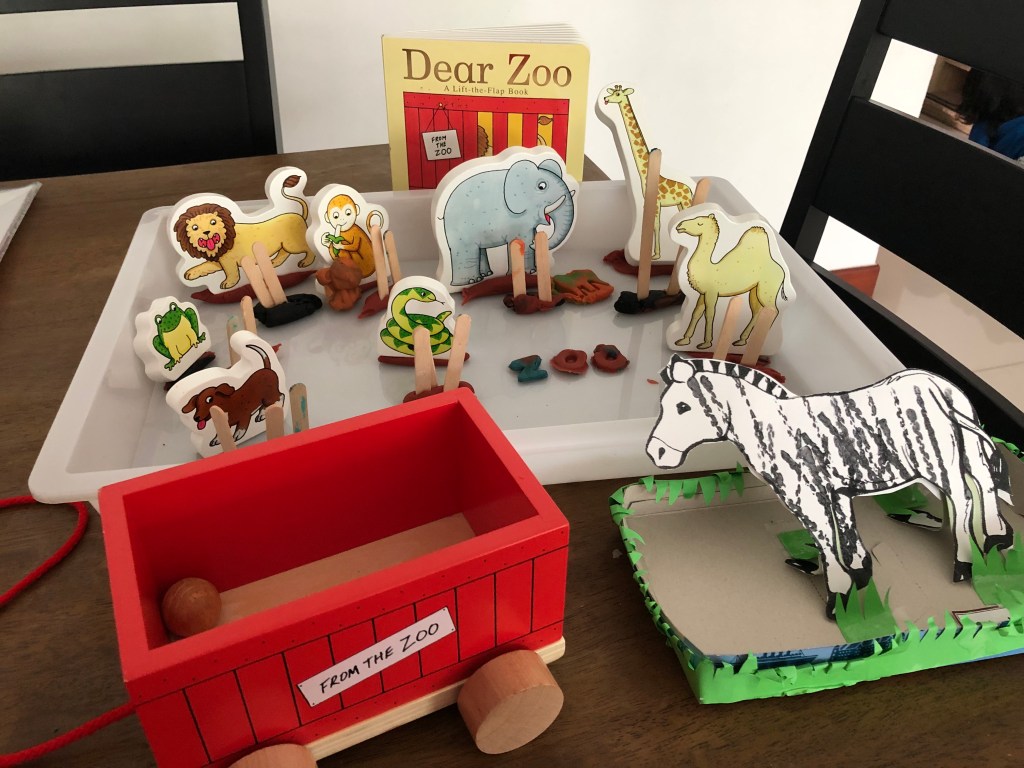
While writing this, Shalem was 3 year and 1 month old. He had mastered all the initial consonants sounds and the vowel sounds. He was able to recognise and write alphabets in both upper and lower case.
The Singapore Stellar Method
In the Singapore Pri EL classroom, we introduce a good book to the class and for the first day or two, devour the book as a class. We ask questions, enjoy the illustrations and try to predict what happens next. Then over the course of 2 weeks, we learn grammar, vocabulary, language features, text structures from the book we read. We have extension activities and it culminates in a writing/creating task where we put all that they have learnt together.

So here I am, trying to mimic something like stellar for Shalem. Here’s to documenting the very raw, very learner centric Dear Zoo journey !
Day 1
We read the book Dear Zoo. We only managed to look at the cover when he was so excited to show me that we can spell Zoo and wrote it out. High interest level is a great start!
We enjoyed the book and he caught the repeated language structure in the book that we could complete my sentence towards the end of the book.
Day 2
We read Dear Zoo again. It is a good practice to reread a familiar book so that your child can pick up key language structures. If you feel that it is getting boring, you can spice it up by speaking in a more exaggerated voice, or getting your child to act as the animal that was being read).
I introduced the Dear Zoo puzzle after we read the book and Shalem was really engaged and ready to piece them together. I threw in descriptions of the animals while we are at it.

It’s great to give related activities as extensions to the book as it helps them to consolidate their learning in another context. Learning becomes more meaningful as well . And anything that is fun and interesting gets retained in our brains longer-I’m sure we all can attest to that !
Day 3
Read book again + animal skittles + play dough—- Some kinesthetic activity for my very kinesthetic person
We built cages for the animals that were “sent back” to the zoo. There are two fold aims in this activity. Firstly, it is to encourage retelling of the story ( Recall = Effortful processing = transferring memory from short term memory bank to long term memory) and second is just for him to enjoy interacting with the play dough and the skittles.
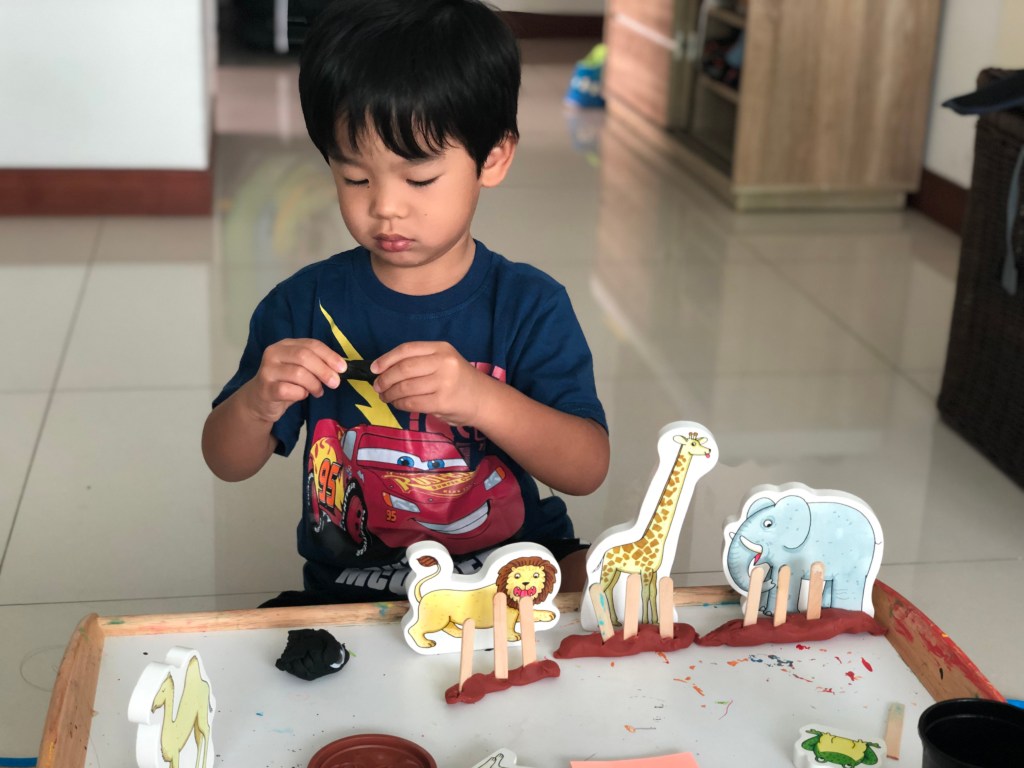
This paid off, his affection for the Dear Zoo book grew and now this book is on his ” Must read” list before bedtime. Kids and adults learn best through play don’t we? He didn’t hold on to the preconceived plan of making cages for long and went on to free playing with his play dough but that’s ok!
Day 4
We skipped book reading today and dived straight to colouring animals and cages. I intend to laminate them and make them into placards for sight word reading. We learnt much about making language visible in our learning environment. It helps the child to absorb language implicitly. But my hubby is a minimalist and loves having plain white walls — so we shall resort to a table top word wall .
Day 5
Reading fun! Exposed Shalem to the spelling of the animals he read about.
Three techniques were employed when teaching reading:
1. Phonetic decoding — sounded out the initial consonant of each word — and can guess the animals using initial consonants alone. He has not yet mastered blending of sounds then. As I reviewed the videos from one year ago, I have been modelling the isolation of sounds and blending techniques! We started this at about 2.5years old and something clicked in him when he was 3y3m , he “suddenly” started being able to blend and read CVC words on his own. This video was taken a year ago, he has yet to master blending and is relying on initial consonants to read.
2. Spelling tricks — Little spelling tricks are effective in helping the child make connection bewteen the words and the noun.
Giraffe starts with a “G” and look , there are 2 tall letters “ff” does it look like 2 giraffes standing tgt?? Gi-rrrr—a-fff

3. Finding a word part within a word “Shalem you know N-O means no. Right. Look at this word “diNOsaur”, the first sound is a “D” , D- i , /Die/, then there is an NO – no. And then a “sssss…uar “ so this is dinosaur. Shalem is a clever toy, he might have made out that a three syllable dinosaur surely is a long word! But I’m not stressing him on the accuracy of spelling now, it’s good enough that he uses whatever tricks he has to link dinosaur to the red T-Rex.
A note on memory retention
- Try to let the child see the words as much as possible. (Paste it around the house, fridge, bedroom, tabletop placard like mine above)
- Use a game to arouse their interest . See videos below. Shalem which one is monkey? Get him to smack, hop, jump the correct word. And get praise when correct. Or hide a particular word and ask your child to find it. Shalem, where is my frog? Can you go find the “eff-arr—ohhh-gee “ for me? Walks around the house and hunts for the correct word with an appropriate number of distractors (other words) on the floor.
- Use and spell out the targeted word in every day life, for eg , I would say, Shalem, can you pass the L-I-O-N to mei mei ? (We have a lion walker. Instead of saying the word lion, we spell it). This method works for Shalem’s retention very well. So much that viewing physical words -BIRD is very effortful decoding, but hearing it being spelt out “Bee-Eye-Arr-Dee” is so painless and almost immediately he would say “BIRD” . I used the same method, I would tell shalem. Hey shalem, look at that black bee-eye-arr-Dee there. Mei Mei would have loved to see this bee-eye-arr-Dee.” And he would often say it back “mei mei look at that bee-eye-arr-Dee. It’s so cute”
- Don’t overteach. Teach only the how much your child can retain. Some children work better learning and mastering one at a time.
- Mastery practice- have appropriate intervals for recall.
This is perhaps one of the most important tricks I’ve learnt in my psychology module of memory when I was an undergraduate. We have to revise and recall what we learnt after some time. And several of such recalls are necessary to convert our short term memories into long term memories.
After teaching the spelling of a word, be sure to have a few rounds of practice immediately, conduct a recall test half an hour later and one more a few hours later. Then , have another recall the next day, and then another time in a couple of days.
Compare Shalem’s speed and accuracy from the first video and the last video =)
Notice that I use recalling and not reading/recognising . This is because recalling is more effortful. The more effort you put in to process or retrieve an information, the more likely you are to remember it. That is why highlighting your history textbook and rereading your once does not help you ace a history test or even rmb much details, but “teaching / retelling” historical events to your toy bear actually helps more. When you retell/recall, you are reorgansing and making sense of the information at hand. This is more effortful than just reading. You can be aware of the pointers that elude you, and you can head back and revise that part again .
Day 6 and beyond
I let Shalem choose what activities he wants to do around this theme. And he ALWAYS goes back to reading the book first, and then playing the spelling and skittles matching game.
Beyond these tasks, IF I am free and up to it, I might search Pinterest for more interesting and hands-on activities online for Dear Zoo. There is a ton of resource for this particular book! Take your pick!
Here is the link to something we did =)
Click link to view free printable from Teacherspayteachers https://www.teacherspayteachers.com/Product/Dear-Zoo-Story-Sequencing-Re-telling-Visuals-FREEBIE-1267109
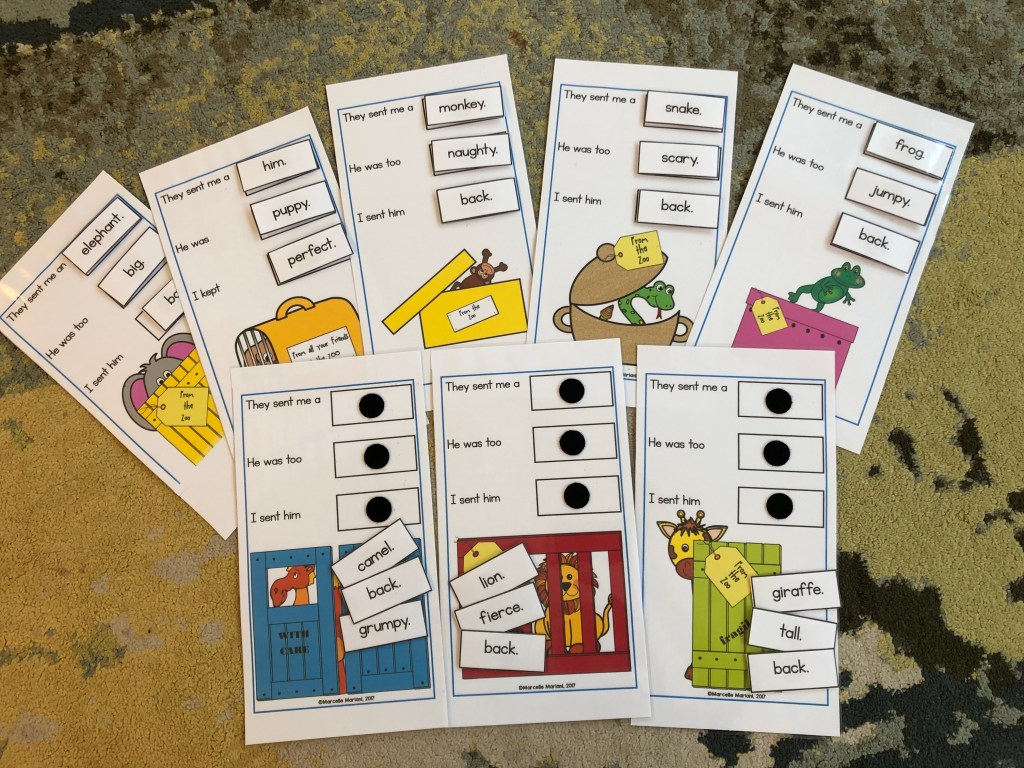
That’s the end of my sharing for Dear Zoo for now, I would love to hear from you if you have interesting ideas for this book!
One year on …..
We have another cute child who is a few months shy of her 2nd birthday. She has picked up the book and its her favourite as well =) My daughter is not as developed linguistically as her brother when he was her age ( but im sure she will catch up in no time), but she enjoys matching the skittles to the animals in the Dear Zoo book!
 Shalem and Shekinah