
Apples • Math • Science• My Father’s World
We have embarked on a lovely curriculum called My Father’s World since the start of the Covid-19 lockdown. There will be another post on this if I have the time, for now this entry will be a continuation of my previous post about early childhood Mathematics. And I will focus on the topic of addition.
Upon writing this Shalem is 3 year 7 months old. We have started him on simple addition concepts and strategies (adding with his fingers) from the start of the year, when he was around 3 years 3m old.
This blog post documents our faithful journey in addition. What a journey! If you would like to see how we added, and what are the pros and cons of each addition method, do have a read!
I used a variety of addition strategies w Shalem such as ten frames, fingers, concrete/ pictorial objects, abacus, putting one number in the head and counting on.
- Adding with fingers (Concrete)
This is probably what all parents can confidently teach their kids and they should do many many many many many rounds of this! This will get them to be familiar with the concept of addition! Shalem was very proud of himself being able to add 3+ 5 quickly but when it comes to 6 + 2 he was fumbled. 6 to him is only one thumb up. And so 6 + 2 = 3.

And its difficult to present 6 and then add opening 2 more fingers on the other hand with the thumb up already. This may be developmental but fingers isn’t a good way for him to add beyond 6 on one side. Because of this fumbling, I thought I needed to expose him to other addition methods below:
2. Drawing objects and adding them (Pictorial)
Shalem doesn’t not take to this method. Firstly, it is time consuming to draw the objects. Secondly, he insists on drawing fine details in the balls or caterpillars which distracts him from the purpose of addition. But some kids take to this method really well! and it is a really versatile tool because it enables you to count up to 20 or more objects with accuracy, compared to only 10 with your fingers. Because he wasn’t comfortable with drawing… we moved on to …..
3. Abacus (Concrete)
We got a really pretty hand me down that Shalem was able to happily input the two quantities to be added in two rows respectively. And we had this amazing obstacle course which the addition with abacus is the last station. He took to it immediately and found that he could add with speed , less mental effort that the drawing, and more accurately than his fingers!
However, he was counting from 1 each and every time. For example in 5+6, he would count the objects in the first row 1…2..3..4…5 and then add on the objects in the second row 6… 7… .8…9…10..11…
When I was teaching a group of 7/8 year olds, there was always a handful of children not having a good number sense. The poor girl/boy has to count from 1 when they add or subtract. Imagine counting 36 dots 😭 and of course making mistakes along the way. Hence I attempted to teach Shalem the next method, putting the part of the equation (set of numbers) in his head and counting on with the next set — to help him in his mental math. Which was not very easy for him at all!
4. Mental addition (Abtract)
Putting the first/larger number in his head and the second/smaller number in his hand and counting on from the second number. This is a very popular strategy I use for primary 1 kids =)
6 +2 = ?
1. Put 6 in your head, and 2 in your hand.
2. Tap your head and say 6, reminding yourselves there are already 6 in your head and
you need not count them from 1.
3. Count on the next 2 numbers on your fingers…. 7…8…
When I first taught him this method, Shalem was around 3.5 years old. I observed that he had a lot of difficulty doing that. I think kids that young are still at the concrete operational age, where seeing is believing. It is hard to put 5 objects in your head and add on 2 more. You have to count them all again from the start! This lead me to read up more on subtilising. And asking my preschool teacher friends what the children are doing in preschool to help with the concept addition.
5. Ten frames (more commonly used in K1 / 4-5years old)
Ten frames are a useful tool for children to learn how to subitise— which is to tell the number of objects in a set quickly wout counting. This makes addition/subtraction easier!
It’s just like how we can recognise the quantity 5 from a die wout needing to count the 5 dots.
We used the apples as the counters for ten frames. Look at how he auto-corrected himself, instead of counting on from 1, he paused and recognised that 2 rows of 5 makes 10!
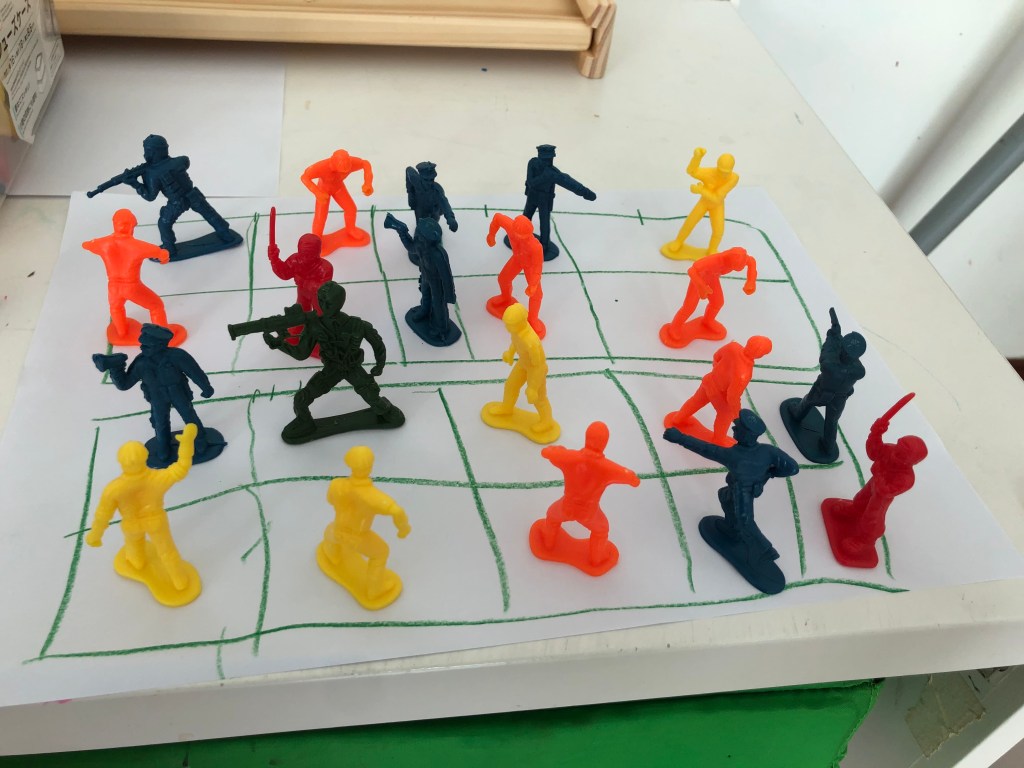
We used soldiers as the counters for ten frames =)
We used dinosaurs too ! (See us add 4 + 3 using ten frames)
After a few months of practice, Shalem has grown more confident in identifying quantities like 6,7,8, 9 quickly and accurately without counting. And then 11,12,13……20 quickly without needing to tax his mental capacity to hold such huge numbers. It is cool as he learns how to subtilise 10 as 2 rows of 5, and 12 as 2 rows of 5 + 2 .
I feel this has helped him to have the metacognition that he can hold quantities of numbers in his head without counting. For instance, he would think, “I can hold 5 counters in my head and add on 2 to make 7. the 5 didn’t disappear, its in row and I don’t have to count them again. “
With the ten frames, it is a way the objects in their head can be concretised. With adequate (many many many) practices, they would know if the first row was filled up, it means there are 5 counters, I need not count 5 again.
That being said, we had weeks of practice where I would count aloud the first row of 5, and then point out that there are 5 in the first row, and then count on 2 more. In the next few weeks, I got Shalem to touch the first row and say, “five” and then count on the next row. He was quick and he would mentally count and give me the total number, but I thought it was a good practice for him to acknowledge that there are five concrete counters in the first row.
The concept of addition requires children to know there A has X number and B has Y number of objects. And you want to find out how many objects there are altogether. Pure rote learning can get children churning out correct answers and knowing the procedures to get the correct answer but they may not know what they are doing.
I want Shalem to know exactly what he is adding and why he is adding items. When we were at the topic of nest, I would tell him Mama bird has 3 worms, Papa bird has 5 worms, how many worms do they have for baby worm? And when we were at the topic of apples, there we are, having him add up the apples in the bag (training him to mentally hold 5 apples in his head).
And he is beginning to get better at the rly advanced skill (for his age) of the putting the first number in his head and then counting on. “5+3 —put 5 in your head, count on 6,7,8 wout starting from 1 all over again). The mental load is great, if he can subitise well, he can hold 5 in his head longer and add on 3 more.
Note: Don’t worry if your child seems to forget what he learnt. When we stopped ten frames for a week, Shalem needed revision too.
My reason for introducing more than one addition strategy
The reason I introduced so many strategies is because i cant figure out which one is the best for him and… isnt math about mental agility and problem solving? So for now we will just explore various ways of addition as long as he isnt confused!
I feel its beneficial for him to be exposed to a variety of methods and then settling on the one he is most comfortable with. The different methods also helps him understand the previous methods more and consolidates the concept of addition.
What we do sometimes is, I would state that he has to try using method X to add 3 questions. And with the last 2 questions he can use any method he likes. He will choose abacus every time!
And I would not interfere with his choice, and allow him to count from 1 as he finds comfortable. I think its developmental and I want him to come to his own conclusion one day,
” WHY am I counting to 5 again when I know that I already inputed 5 in the first row? Oh, I actually know that I can hold 5 in my head from the practices from 10 frames.Let’s count on after 5 ”
And in FACT, HE SHOWED SIGNS OF THIS last week, after 3 months of practices ( WE don’t do addition daily, maybe 2 days in a week with some weeks of break in between, and only 5 min a time). I am so happy.
So far his fav and most comfortable strategies is still his fingers for small numbers, and abacus (adding 2 rows) for bigger numbers. Yay, I know what is my child’s fav addition method. I am so glad to know that. I know particular students’ favourite method, and I’m glad I know my own son’s too! I am so glad to be ur Math teacher Shalem:)
AND mummies, you are the BEST teacher of your child, you know if its better to stick with one method and fully grasp that first before moving on to others. You know if counting dumplings off the dining table works best for your child! =)
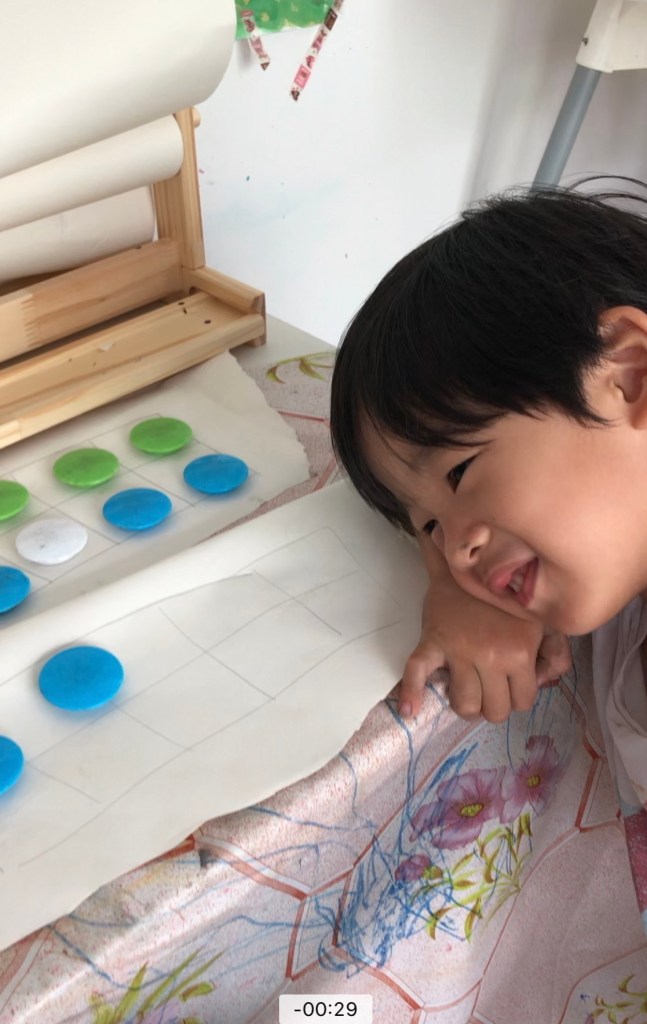
Math requires practice, have fun while at it!
 Shalem and Shekinah
One thought on “Many roads to addition”