I haven’t been the most enthusiastic in teaching Mathematics. Perhaps I feel that English is so much more interesting/varied/challenging to teach.
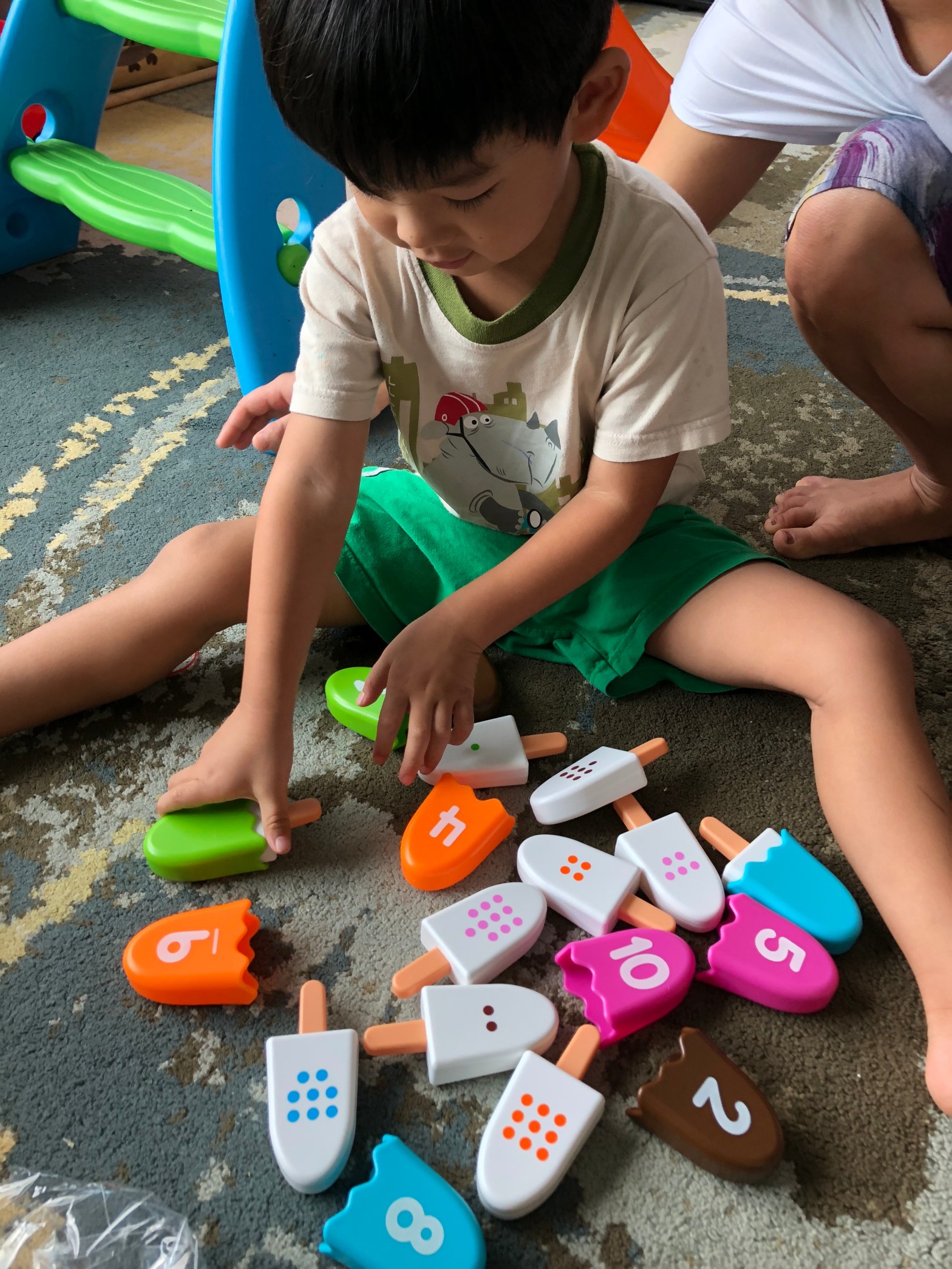
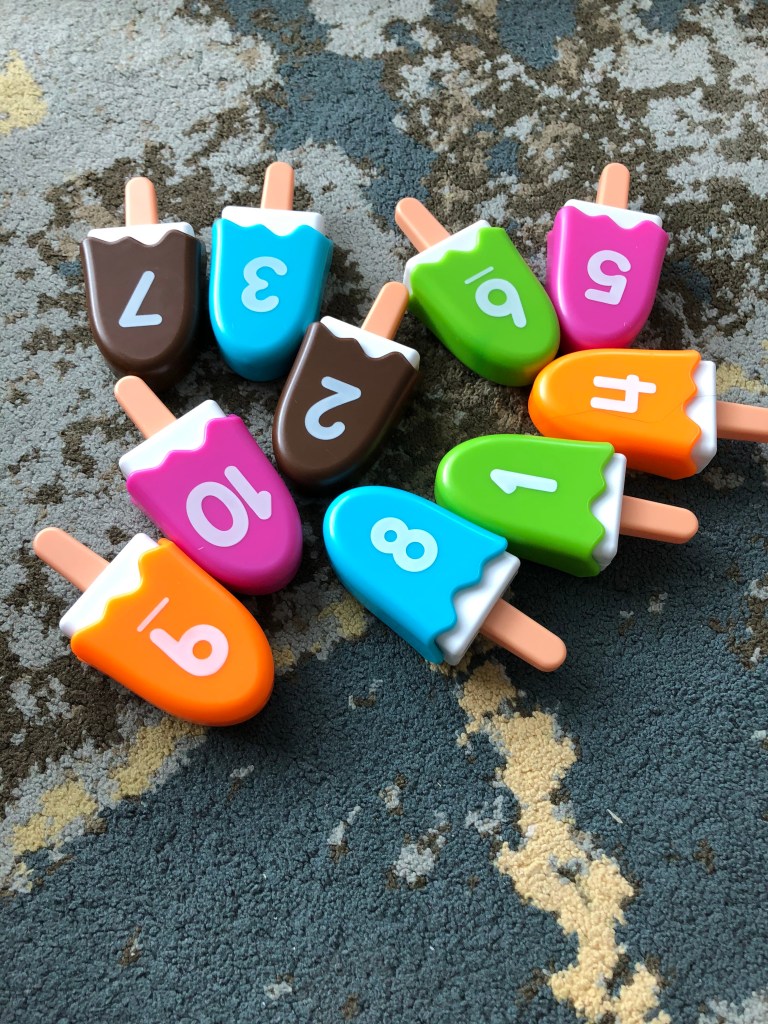
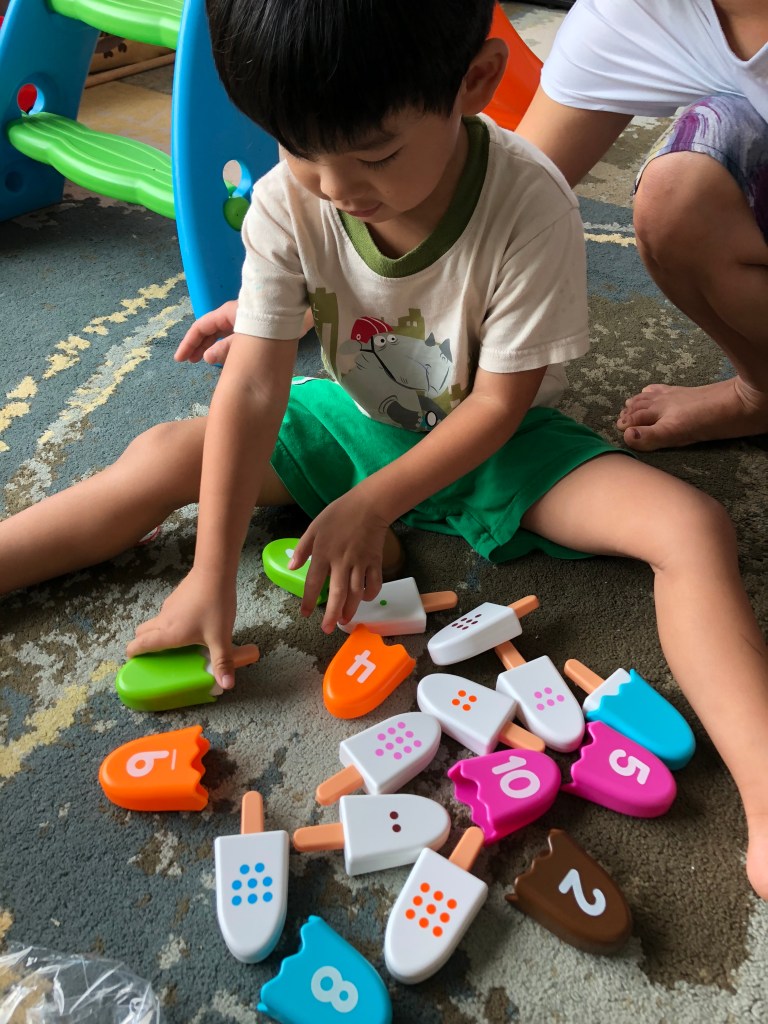
But I found a gem of a counting set and decided to document the various ways that parents can have fun doing Math with their todds at home! I’m trained in Primary education, not sure if it’s the Ecda model, but I thk it shud be similar 
Math is a conceptual subject that success in more complicated algorithms builds upon previous knowledge and mastery. It’s important to teach a concept slowly and clearly step by step and get ur child to master the each step/skill/concept first before moving on to the next step/level/procedure. For e.g. not to teach the addition / multiplication algorithm before the child grasp the CONCEPT of addition and multiplication.
I’ve started Mathematics concepts with Shalem early! And this was the sequence of concepts and activities that Ive taught him.
1) Counting off 1-10 using rhymes/song.
We do random counting on from 1-10 and sing nursery rhymes throughout the day. Eg, 1,2,3,4,5 once I caught a fish alive. 1,2 buckle my shoe etc. My mil allowed Shalem to watched youtube , so he has also picked up counting (NOT counting on) through the song and rhymes on youtube as well.
2) Introduction to Counting on – one to one correspondence of numbers with every day objects.
I thk we started when Shalem was around one ( I haven started with my 15m baby girl cuz she isn’t ready, read disclaimer below ). We counted soft toys and cups at home , cookies when we were out and cars on the road. It’s important for them to attribute ONE number to ONE object when counting on. Parents can point to objects when counting on slowly. It is ok if they don’t count along or can’t count accurately for now. Just getting them into the habit and wonder that objects CAN be counted is a great start. I recall lazy mornings where he would stand at the window and looked at the passing cars below and count them, albeit not accurately yet. He was a year plus so it was ok! The act of counting on his own initiative was an encouragement to me.
3) Being able to recognise numerals to 10 (and then to 20)
We (My mil and I as she was looking after Shalem full time then) used a combination of books and flashcards(gulp) to teach Shalem the symbols that represented each number (1 is one, 3 is three). I believe learning should be fun and active , especially for toddlers, hence I took my mil’s flashcard and place it around the house. I asked Shalem to run to / crawl/ hop/ hi-5/pick for me the numbers that I call out. And I celebrate each success with loud applause and affirmation. He had a whale of time doing this.
I believe in starting slow and not moving on to the next thing before mastery, so it would look like. “Shalem, this is number 1. I put number 1 on the floor now. Can you hop on number 1? Wow! Great job!!!” If he is up to it, I would show him another number. “Shalem this is 2. Look it has a curve and a straight line. Can you draw 2 in the sky with your hands? Can you draw 2 with you butt? Ok, I will put number 1 and 2 on the floor. I want you to hop onto the correct number when I call out ok? Ok Shalem hop to 2! “
How I added kinesthetic and game element to teaching.
I also believe in pointing out numbers to kids when we are outside, so they can see how numbers are used in their environment (IMPT thing that Ive learnt in NIE). We point out numbers in blocks of flats, numbers in buses, numbers on food items etc. From that Shalem learnt that numbers can be used to represent objects, and represent quantity / weight as well. He loved the number 16 because we lived on the 16 floor.
With just these methods, Shalem mastered recognizing and counting on the numerals 1-20 well before his 2nd birthday! Cant remember exactly when but our second child arrived when he was 2 years and 2 week old and since then the formal teaching of mathematics ceased. What we did for one whole year was just counting objects in our environment, maybe tracing some numbers here and there =)
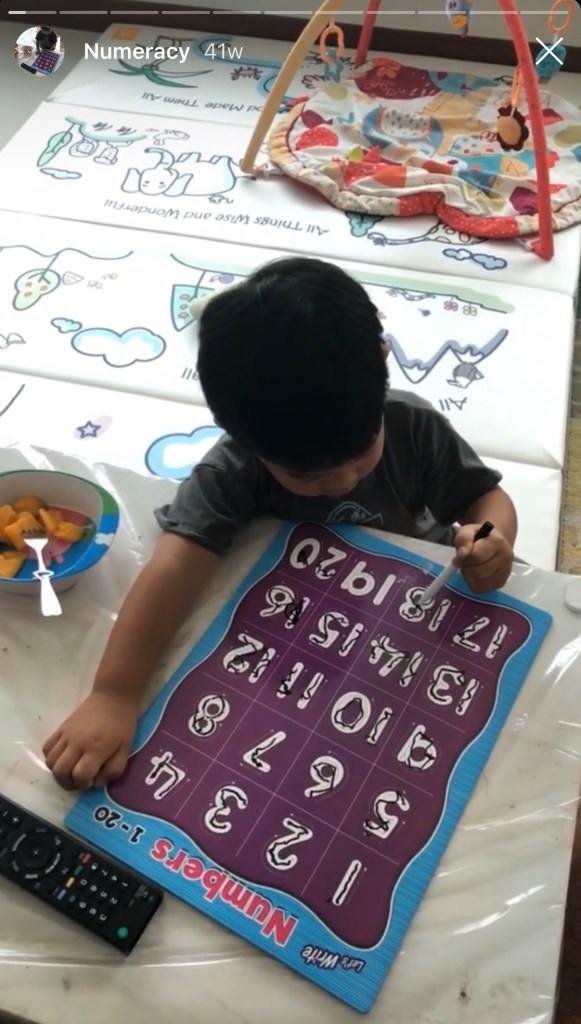
4) Being able to see the quantity or 2 / 3 without counting.
I must have said to Shalem, “Look there are 2 cars” etc when we are out. One day he told me, “mummy, two dogs.” He obviously didn’t count them but could grasp the concept of 2. I think its also a essential skill to be able to “see” the quantity of small objects without counting. It would have been terrible for us as adults or housewives right, if we we cannot roughly estimate how many Tupperwares we have on the drying rack at a glance and have to count from one. I realised some of my special needs students are not able to do that, and counted from one every single time even though there were only 3/4 objects. It was painful to watch especially when we are doing multiplication (YES p1 topic). A strategy of bundling in 5s or 10s would be helpful for her. Hope I will have time to share more about this in the future.
5) More deliberate practices of really counting how many objects there are. We call this skill one to one correspondence of object and number. This is actually the first lesson of P1 mathematics. Without having this prerequisite, a child will have problems understanding the concept of addition, or more and less, and even of subtraction. For a period of time, Shalem was randomly counting to 10 for all objects I asked. It was really funny, he HAS to count to 10 , even thought there were 5 balls on the table. I think this is part of his development, children like to see things done in “completion” and counting to 10 was part of this. It was an AHA moment, when he realise that things can be less than 10.
The way I taught him this was to get him to count objects slowly, point to each one (I placed them on a line) and when the objects ran out, I would exclaim, “STOP!” And we both would laugh. After a few tries, he would mimic me. He would count on and then say “STOP” when there were no more objects. This was the start of him understanding one to one correspondence. To build on his mastery and accuracy, we had more practices counting things at home and out.
How I taught him that he need not count on to 10 each time we are counting objects.
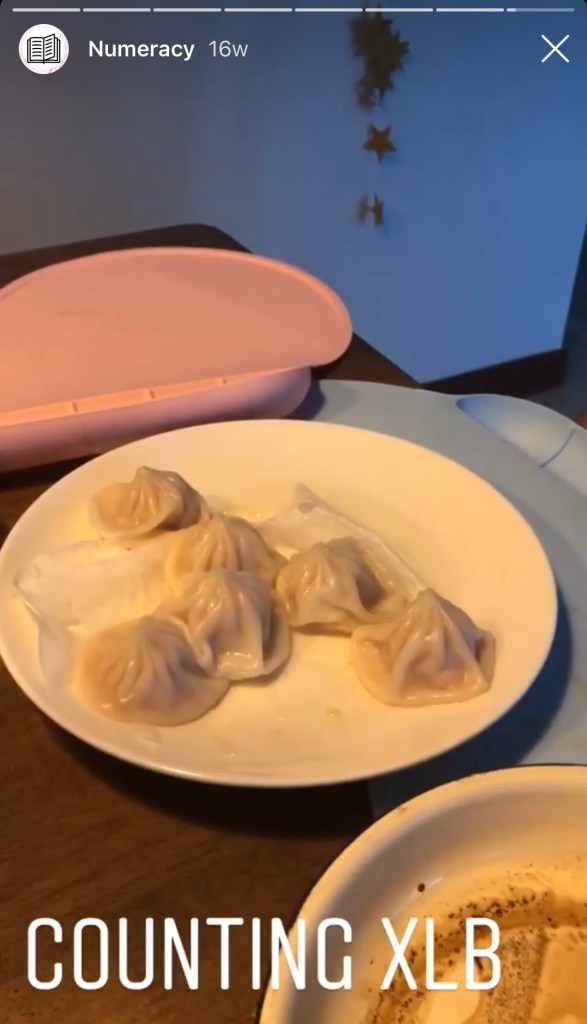
Here’s a summary of what Shalem could do( Prerequisite skill) before the popsicle game:
- Able to count objects to 5 (one to one correspondence)
- Knows that one object correspond to one number and there isn’t repeated counting or counting on to 10 when they are only 5 dots.
What we worked on with this set of tool (Or my own lesson objectives)
1. One to one correspondent counting for objects more than 5. I feel he has good accuracy up to 5, and then he will be inpatient and randomly count on. (As seen in the video below). But he can count objects to 10 if asked to slow down. So that’s what we did. Practice makes perfect! And counting will get less effortful and more automatic .
2. Strategy for counting
You may be surprised but some of my p1 kids counted the same way as Shalem in the first video! Hapzard counting and objects get counted twice as they don’t know which object was counted before. So I feel it’s important to teach strategies for counting objects – left to right, top to bottom.(See video above) This is a far reaching skill don’t you think? We count objects so often.
3.Verbal recall, short term memory
Found it fun to just test and see if he can hold 3 numbers in his short term memory and he could! He can’t do 4 numbers yet ! Chunking and holding numbers in short term working memory is crucial to solving more complicated maths problems in the future.
4.What comes next?
I wanted to do this as “number patterns” is a weak link observed in my p1/2 kids.
Of course they can do simple straight forward questions like “2,3,4 ___ 6”. But once it’s a skip counting pattern , they get confused and frustrated.
A sense of number line is important to help in the above. By helping them see numbers in a continuation on a line, they get more comfortable in telling us what is missing.
To make it more fun, I got shalem to do a telematch with me. I placed some numbers at the other end of my hall and Shalem (and me) has to go take one number at a time and put it in the correct place before the other can go.
We are practicing turn taking too! Killing two birds with one stone.
Kids learn best with more senses employed, and kids also learn best through play
Please pardon my grammar, this was done over 3 weeks in bouts of 10minutes and now im too tired to look through them. I will review it again =) Enjoy!
Check out more numeracy and literacy ideas on my IG https://instagram.com/shalemshekinah
Disclaimer:
Shalem is a very fast learner, and he IS enthusiastic to learn. But don’t be pressured to start early as it will backfire and even hinder future learning. Learning at home should be filled with fun and joy!And lots of affirmation and encouragement. Our children catch on our joy and learn really quickly ! Mei Mei isn’t ready for any ” formal” math yet at 15 months. We also don’t do screen time with her. What I do with her is just singing songs/rhyme 1-10 and counting toys/ books / spoons of milk milder as I pour them into her milk bottle. Nothing is quite caught on yet, but each child learns and bloom at their own pace =)
 Shalem and Shekinah
One thought on “Teaching Numeracy”